Pages

" Vegetables are the food of the earth, fruit seems more the food of the heavens." (Sepal Felicivant)
Showing posts with label herb. Show all posts

September 20, 2008

Common Indonesian Herbs and Spices for Daily Cooking

Common Indonesian Herbs and Spices for Daily Cooking

Indonesian cuisine is popular with its variety spices and herb use in cooking process. It makes Indonesian cuisine has a very rich on taste. Here there are. I tried to collect them in the list.

If I find another spices or herb which is not included in this list, I’ll add them later.

English

Bahasa Indonesia

Onion

Bawang

Garlic

Bawang putih

Shallot

Bawang merah

(red/green) Chilli

Cabe (merah/hijau), cabe keriting

Hot Chilli

Cabe pedas(rawit)

White pepper

Lada putih

Black pepper

Lada hitam

Green onion

Daun bawang

Turmeric root

Kunyit

Galangal root

Lengkuas

Greater galingale (Kaempferia galanga)

Kencur

Ginger

Jahe

Candle nut

Kemiri

Leek

Daun bawang

Spring onion/green onion

Daun bawang

Turmeric leaf

Daun kunyit

Salam leaf

Daun salam

Cardamom

Kapulaga

Caraway (Carum carvi)

Jinten

Star Anise

Bunga Lawang, Peka

Nutmeg

Pala

Clove

Cengkeh

Fruit of Kepayang Tree

Keluwek/keluwak

Flowering garlic chives

Bunga bawang

Lemongrass

Serai

Lime leaf

Daun jeruk purut

(A kind of) Indonesian very sour lime

Jeruk nipis

Lime

Jeruk limo

Coriander seed/ground

Biji/bubuk ketumbar

Coriander leaf

Daun ketumbar

Curry leaf/ground

Daun kari/ bubuk kari

Lemon Basil leaf

Daun kemangi

Celery leaf

Daun seledri

Cumin (Cuminum cyminum ) seed/ground

Biji/bubuk jintan

Garlic chives

Kucai

Sesame seed

Biji Wijen

Tamarind

Asam Jawa


September 12, 2008

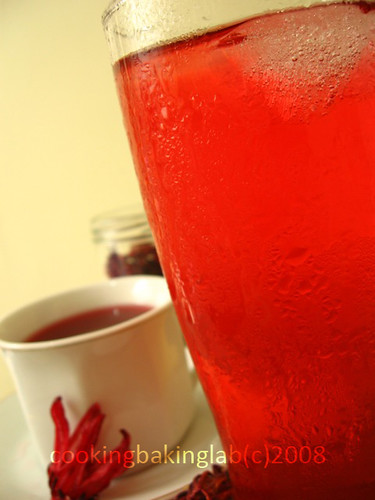
Bright Red Tea, Hibiscus Tea..


Hibiscus sabdariffa, I bought one small pack of dried roselle’s calyx at delicatessen nearby. Commonly, Indonesian people say it is roselle’s flower due to widespread misinterpretation. It is not flower but part of flower to protect a flower before it opens, CALYX.

Roselle have planted in Indonesia for a few hundred years ago. People used its fiber just like jute. But lately people also use it for food and drink. The dried calyx processes into rosella jams, syrups, and tea.

To make some tea, simply pour 250 ml boiling water on 3 to 5 dried rosella’s calyxes. Wait until it turns into bright red color. Press them with teaspoon may help them become red faster than just leave them. Add amount of sugar cube, stir. You can drink it cold or warm. Fresh but sour. Off course it is sour, because of the high level of vitamin C. So be careful of your stomach.

Wikipedia said that Hibiscus sabdariffa’s calyxes are rich in Anthocyanins. These pigments are responsible for the bright red to crimson red color of our Hibiscus tea here, depends on how many dried calyx we use. Not only take a role as the major pigment in this dried calyx, but Anthocyanins also take a part as antioxidant.

The dried calyxes are also rich in flavonoids content. That’s why people around the world use it for several folk medications. Some researchers found that hibiscus tea has anti hypertension effect in type II diabetic patients (with mild hypertension) so that it is reasonable when folk medication use it to cure people’s mild hypertension.


You can read Bahasa Indonesia version of this similar posting in my other blog.


Link:

http://www.ncbi.nlm.nih.gov/sites/entrez

http://lpi.oregonstate.edu/ss01/anthocyanin.html

http://en.wikipedia.org/wiki/Hibiscus_sabdariffa


AddThis Feed Button
Related Posts with Thumbnails